
Building Permit Forms & Downloads
We’ve put together a collection of helpful resources to guide you through common aspects of the building approval and compliance process in Victoria.
Forms To Fill Out
1. Application for a Building Permit
2. Letter of Appointment
3. Final Certificate Declaration
Planning Permits: What You Need To Know
A planning permit is a legal document issued by your local council that grants permission for a particular use or development of land. It is entirely separate from a building permit, and the two are often confused.
When Is A Planning Permit Needed?
Whether you need a planning permit depends on the local planning scheme for your property. Common triggers include:
- Building in a heritage overlay
- Subdividing land
- Building on land in a bushfire management overlay
- Extending a dwelling in certain residential zones
- Certain agricultural or commercial uses
How Does It Relate To A Building Permit?
A building permit cannot be issued if works require a planning permit that has not yet been granted. If your project requires both, obtain your planning permit first, then proceed with the building permit application.
Where To Get A Planning Permit:
Planning permits are applied for through your local council. We are happy to advise you on whether your project may require one before you proceed. For formal planning advice, you should consult your council’s planning department or a town planner.
Domestic Building Insurance In Victoria
Domestic Building Insurance (DBI), sometimes called Home Warranty Insurance, is a mandatory insurance product in Victoria for certain residential building contracts. It protects homeowners in the event that a builder becomes insolvent, disappears, or dies before completing contracted works (or before a defect claim is resolved).
When Is It Required?
DBI is required for domestic building work where the contract price is more than $20,000. Builders must take out DBI before beginning works or accepting a deposit from a homeowner. Proof of insurance must be provided to the homeowner before works commence.
Owner Builders:
If you’re an owner builder and you plan to sell your property within 6.5 years of the building permit being issued, you may be required to obtain owner builder warranty insurance depending on the value of the works.
Where To Obtain It?
DBI in Victoria is provided by the Victorian Managed Insurance Authority (VMIA). Your builder should arrange this on your behalf.
Note: We recommend confirming your requirements with a licensed insurance professional and consulting the VMIA website for up-to-date information.
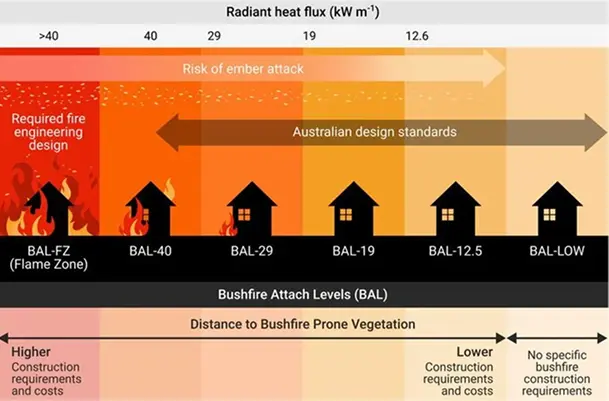
Bushfire Attack Level (BAL) Explained
If your property is located in a designated bushfire-prone area, any proposed building works must take the Bushfire Attack Level (BAL) into account. North East Victoria contains a significant amount of bushfire-prone land, so BAL is a common consideration for our clients.
What is a BAL Rating?
A BAL rating measures the degree of risk from ember attack, radiant heat, and direct flame contact associated with a bushfire. The higher the rating, the more stringent the construction requirements.
How Is It Determined?
BAL ratings are determined by assessing vegetation type, slope, and the distance of the building site from the assessed vegetation. The assessment follows the methodology in AS 3959: Construction of buildings in bushfire-prone areas.
What Does It Mean For My Build?
A higher BAL rating requires the use of more fire-resistant construction materials, window glazing, and roof and wall systems. This can affect project costs and design. Your building permit will specify the BAL for the site.
Do I Need A Formal BAL Assessment
For most building permit applications in bushfire-prone areas, a formal BAL assessment prepared by a suitably qualified assessor is required. We can advise you on whether this applies to your project.
Home Warranty Insurance
When Is It Required?
Victoria: From 1 July 2026, Home Warranty insurance replaced Domestic Building Insurance (DBI) as the mandatory cover builders must purchase on behalf of the homeowner. It applies to domestic building contracts over $20,000 for homes of three storeys or less. Homeowners are automatically covered from the moment the building contract is signed, with the builder required to pay the premium to the Building and Plumbing Commission within 10 business days of signing the contract or works commencing, whichever is earlier. Existing DBI policies issued before 1 July 2026 continue under the previous scheme on their original terms.
NSW. The equivalent scheme is Home Building Compensation (HBC) cover, provided through icare. It is required for residential building work where the contract price is more than $20,000 (including GST), and the builder must hold cover and provide the homeowner with a certificate of insurance before starting work or accepting any payment.
What Does It Cover?
Victoria: Home Warranty operates as a first resort scheme. Homeowners can claim for incomplete, defective or non-compliant building work without first having to prove the builder has died, disappeared or become insolvent. a significant improvement in consumer protection over the previous last resort model. Maximum cover is $400,000.
NSW. HBC cover remains a last resort scheme. It responds only where the builder has died, disappeared, become insolvent, or had their licence suspended for failing to comply with a court or tribunal compensation order. Cover extends for six years from completion for major defects and two years for other losses.
Where To Obtain It?
In Victoria, Home Warranty insurance is issued and administered directly by the Building and Plumbing Commission (BPC), which has also taken over management of claims under older DBI policies. In NSW, HBC cover is provided through icare via approved distributors and brokers. In both states, the builder arranges the cover. as a homeowner, your job is to confirm cover is in place before paying any money.
We recommend confirming your requirements with a licensed insurance professional, and consulting the BPC website (bpc.vic.gov.au) or icare (icare.nsw.gov.au) for up-to-date information.